Building insurance in the canton of Vaud: what the ECA really covers and what it does not
In the canton of Vaud, every property owner is automatically insured with the ECA, the Cantonal Insurance Institution.
- The ECA, a system rooted in Swiss tradition
- What the ECA actually covers
- Fire risks
In the canton of Vaud, every property owner is automatically insured with the ECA, the Cantonal Insurance Institution. A mandatory and often misunderstood protection, which nonetheless leaves significant gaps that many discover only at the time of a claim.
The ECA, a system rooted in Swiss tradition
Switzerland is one of the few countries in the world to have developed a dual property insurance system: on one side, cantons with a state monopoly, on the other, cantons where the private market is free. Vaud belongs to the first group. Of the 26 Swiss cantons, 19 have a monopolistic cantonal insurance institution (ECA), covering both German-speaking Switzerland (Zurich, Bern, Lucerne, etc.) and French-speaking Switzerland. The Vaud ECA, founded in 1811, holds the monopoly on fire and natural-hazard insurance for all buildings in the canton. There is no escaping it: as soon as a building is constructed or acquired, it automatically enters the system.
This model has an undeniable advantage: universal coverage, without risk selection, at generally moderate premiums. Risk pooling operates at the cantonal level, which also allows the ECA to fulfill a mission of prevention and of assistance to municipalities after natural disasters. But this solidarity has its limits, and the owner who believes they are "fully covered" by their ECA affiliation is taking a real risk.
What the ECA actually covers
The ECA's coverage relates to two main categories of risk: fire and natural hazards. These concepts cover a precise scope, defined by cantonal law (LAEIN) and the institution's general terms.
Fire risks
- Fire, explosion, implosion
- Damage caused by lightning (direct strike)
- Damage resulting from a fire: smoke, heat, extinguishing water
- Demolition and debris removal costs within certain limits
Natural hazards
- Flooding, high water, water backup (subject to conditions)
- Storm, hail, avalanche, snow pressure
- Rockslide, landslide, falling rocks
- Subsidence of the natural ground
In both cases, it is exclusively the building that is insured, in its structure and fixed installations. The insured value is determined by the ECA itself, on the basis of an official estimate that is regularly updated. The compensation is intended to allow the building to be rebuilt as new, as it was before the claim.
The ECA covers your building, not its contents, not your liability, not everyday water damage: understanding this boundary is the first step toward building truly complete protection.
The significant gaps: what the ECA does not cover
This is where the surprises happen, often in already difficult moments. The ECA's scope of exclusions is wide, and every owner should know it even before signing a deed of sale.
The contents of the building
The ECA insures only the built envelope and its fixed equipment: walls, roof, integrated sanitary and electrical installations, heating. Everything that can be moved, namely furniture, household appliances, valuables, a shop's stock or tenants' removable fittings, is not covered by the building insurance. For an owner who occupies their property, it is household contents insurance (also mandatory in the canton of Vaud with the ECA) that takes over. For an investor who rents out, it is up to the tenant to insure their own contents.
Water damage not linked to natural hazards
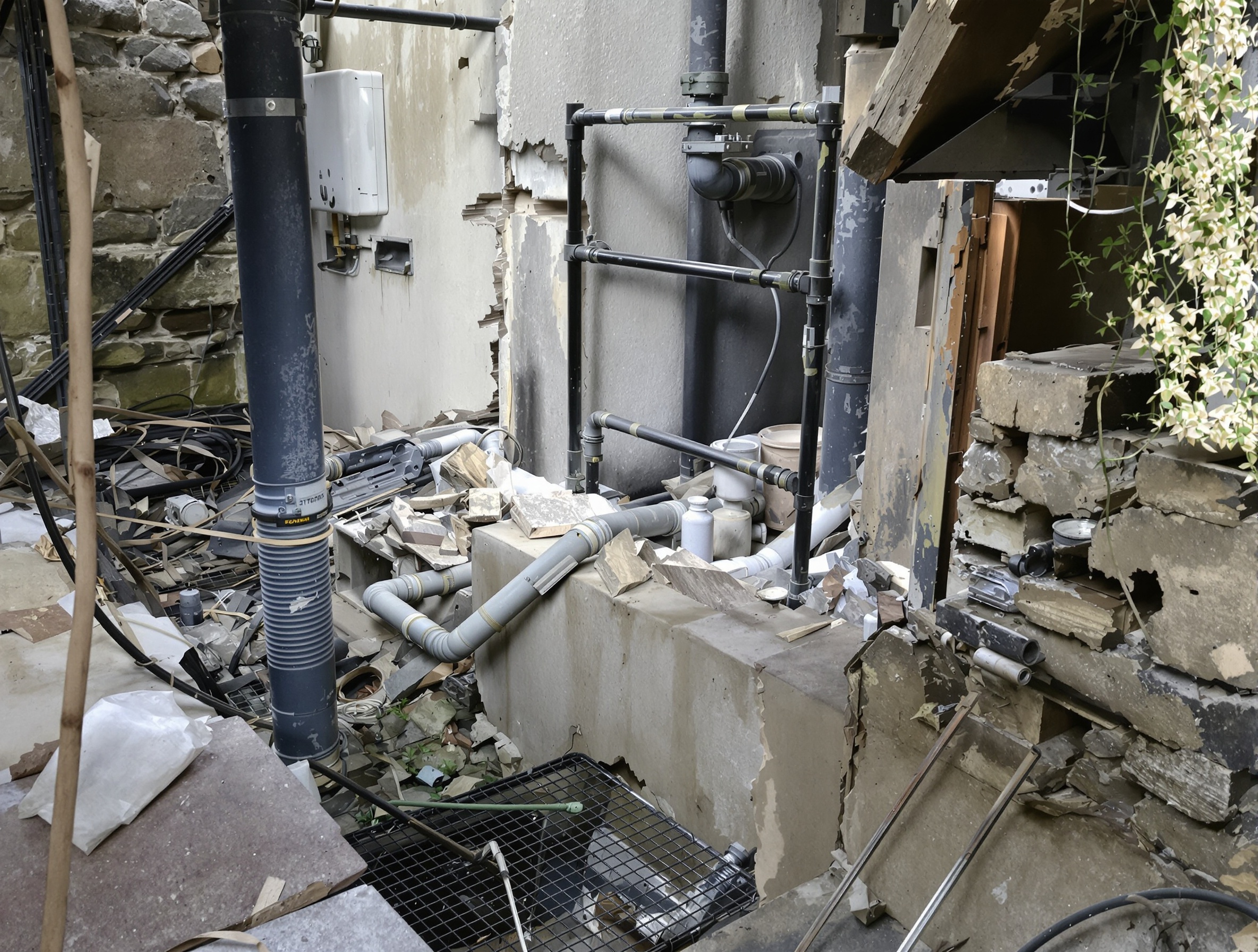
This is one of the most frequently overlooked gaps. A burst pipe, an ordinary roof leak, damage caused by a faulty sanitary installation: none of these claims is covered by the ECA if it is not directly linked to a covered natural event. Yet this so-called "technical" water damage is among the most frequent in the Vaud property stock. Without supplementary insurance, the owner bears the repairs alone.
The building owner's civil liability
If a third party is injured on your property, if your roof damages a neighbor's vehicle, if a falling tile causes an accident: the ECA does not step in. The building owner's civil liability is a separate cover, to be taken out with a private insurer. It is essential, whether for a villa, a rental building or a condominium.
Other notable exclusions
- Cosmetic damage without structural impact (superficial cracks, discoloration)
- Breakdowns of appliances and installations (boiler, lift)
- Intentional damage or damage linked to manifest lack of maintenance
- Loss of rental income exceeding the ECA's basic cover (limited to 5% of the compensation allocated), often insufficient for an income property
- Costs related to bringing the property up to standard after a claim if regulatory changes have occurred since construction
- Property not declared or undervalued in the insured value
- Earthquake damage (excluded from coverage, although an intercantonal pool may step in under certain conditions)
The particular case of condominiums and collective buildings
In a condominium, it is the community of co-owners that is affiliated with the ECA for the building's common areas. The premium is allocated among the units according to the ownership shares. But each co-owner remains personally responsible for their exclusive installations and, above all, for their own contents.
For rental buildings held by a single owner or a company, the ECA affiliation covers the entire building. The investor must nonetheless ensure that the insured value is correctly estimated: an undervaluation can lead to partial compensation in the event of a major claim, under the principle of underinsurance. A review of the ECA value whenever the property is altered or extended is strongly recommended; this can be done free of charge by the ECA's valuation commission.
How to effectively complete your coverage
Truly solid property protection in the canton of Vaud relies on the ECA as a foundation, to which several private covers are added. The ideal combination depends on the owner's profile: occupier, landlord, investor or co-owner.
For an owner-occupier
- Household contents insurance covering contents and interior water damage
- Private civil liability including the capacity of building owner
- A water-damage option on the building (available from several private insurers as a complement to the ECA)
- Glass-breakage insurance if the villa has large glazed surfaces
For an investor or a landlord
- Building civil liability, distinct from private civil liability
- Supplementary loss-of-rent insurance in the event of a claim rendering the dwellings uninhabitable
- Coverage of technical installations (lift, boiler room, photovoltaic panels if not declared to the ECA)
- Owner's legal protection, useful in the event of a dispute with a tenant
The mistakes to avoid
- Believing that the ECA is enough and not taking out supplementary cover
- Failing to report to the ECA works that significantly enlarge or enhance the building
- Confusing the ECA's building cover with the owner's civil liability
- Not reading the general terms of supplementary contracts to identify overlaps or blind spots
- Forgetting to update the covers after a major renovation
The procedure in the event of an ECA claim
In the event of a covered event, the owner must report the claim to the ECA as soon as they become aware of it. The law allows a maximum period of two years from the date of occurrence, but a prompt declaration is strongly recommended to facilitate assessment and speed up compensation. The ECA then appoints a specialist to assess the damage and determine the compensation. A few practical points are worth knowing in advance.
- Document the damage immediately with photos and videos before any cleanup
- Keep the invoices for emergency protective measures (tarping, pumping) as they are covered by the ECA
- Do not undertake permanent repair work before the ECA expert's visit, except in cases of absolute emergency
- Check that your insured value is up to date: underinsurance identified at the time of the claim can proportionally reduce the compensation
If a disagreement arises over the amount of compensation offered, cantonal law (LAEIN) provides for specific remedies: it is possible to challenge the decision before the court within 30 days of its notification. In complex situations, particularly after a major claim affecting several properties or involving third parties, the support of a property management specialist can prove valuable in coordinating the various parties.
The ECA, a powerful tool but no substitute for an insurance strategy
The ECA is a remarkable institution, in the true sense of the word: it offers universal coverage, without discrimination, for the two most devastating risks that threaten a building. But no prudent owner can be content with this affiliation alone. Real estate often represents the most important investment of a lifetime or of a business: it deserves a careful reading of the covers in place, a regular review and a well-thought-out complementarity between the ECA and private insurance.
At Homewell, we regularly support our owner and investor clients in this clarification exercise. Not to sell insurance, but because a well-managed building is also a well-protected building. A poorly covered claim can turn a fine acquisition into a financial pit: it is better to think it through calmly, before the problem arises.
A sale project, even with tenants in place?
Our brokers support you at every step, by the book. A well-argued valuation within 48 hours.
Further reading.

- Finance
- June 4, 2026
Mortgage rates: fixed, variable or SARON, how to choose right now?

- Swiss law
- June 4, 2026
Rental deposits in Switzerland: the alternatives to a blocked deposit account that few tenants know about
- Swiss law
- June 1, 2026
Condominium charges in Switzerland: what every owner really needs to know
Get a free valuation of your property or talk it through with our team, in Lausanne and on the Vaud Riviera. No obligation.
Real estate received as a gift and then resold on the Vaud Riviera: how the reference value is calculated for the capital gains tax

Buying a Tenant-Occupied Property: What Buyers Don't Always Realize Before Signing

Easements and Neighbor Law on the Vaud Riviera: What Your Purchase Agreement Does Not Always Make Clear